9 Best Budget Friendly Espresso Machines (November 2026)
The best budget friendly espresso machines include the Lavazza BLUE Classy Mini Single Serve Espresso for capsule simplicity, the Neretva 20 Bar Espresso Machine Super Compact for barista practice on a budget, and the Nespresso Vertuo Pop+ Coffee and Espresso Machine for coffee and espresso in one.
On this page (5 sections)
The best budget friendly espresso machine for most people is the Lavazza BLUE Classy Mini, because two touch buttons and Lavazza Blue capsules get you an espresso or lungo without a grinder, a tamper or a learning curve. If you would rather grind and tamp your own coffee, the Neretva 20 Bar is the pick.
"Budget friendly" can mean a few different things, so it helps to say which one we mean. Here it means a machine that is easy to start with and does not ask you to buy a pile of extras before the first good cup.
This list takes a different angle from our general budget guides: it splits the field by how you want to make the cup. Capsule machines trade variety for speed, while pump machines trade convenience for control and a separate grinder.
That split matters more than any single spec. Someone who wants a quick shot before work and someone who wants to learn to pull shots and steam milk are shopping for very different machines.
Two of the machines here take sealed pods, and the rest take ground coffee. The pump machines all use a portafilter, so you grind, dose and tamp each shot yourself, and none of them has a grinder built in.
It is worth knowing the trade-offs before you buy. Pods lock you into one brand's capsules, and pump machines take a week or two of practice and a grinder you may not own yet.
Milk drinks are the other dividing line. Only the pump machines with a steam wand can froth, and the two pod machines here have no wand.
Size varies a lot too. Some of these are barely 5 in wide while others need a full shelf, so we point out width, depth and height as we go.
Whichever way you lean, plan on a little upkeep. A rinse and an occasional descale keep any of these running well.
Read on for a pick for each kind of drinker, then the specs that actually change the cup. Our guide to the best semi-automatic espresso machines covers the pump side in more depth if you lean that way.
Best budget friendly espresso machines at a glance
Lavazza BLUE Classy Mini Single Serve Espresso: Best for capsule simplicity

- 2 touch controls for espresso or lungo
- 1 programmable free dose
- 5.3 in wide cabinet
- 23.67 fl oz water capacity
A capsule machine that brews espresso or lungo from two buttons and takes up less counter width than anything else here.
Pros
- Smallest width in this group
- Programmable dose for a custom cup size
- No grinding or tamping needed
Cons
- Brews only Lavazza Blue capsules
- No steam wand for milk
Neretva 20 Bar Espresso Machine Super Compact: Best for barista practice on a budget

- 20 bar pump with 1350W boiler
- Low pressure pre-infusion
- Temperature display
- 1.31 L removable tank
A compact pump machine with a steam wand and pre-infusion, so you can pull your own shots and froth milk without spending much.
Pros
- Steam wand for milk foam
- Temperature display
- Pre-infusion for a more even extraction
Cons
- Needs a separate grinder
- Heaviest pick at 17 lb
Nespresso Vertuo Pop+ Coffee and Espresso Machine: Best for coffee and espresso in one

- 5 cup sizes from single espresso to 12 oz coffee
- 30 second heat up
- 25 fl oz removable tank
- One-touch brewing
Brews a full mug of coffee or a short espresso from the same machine, which suits a household that wants both without two appliances.
Pros
- Five cup sizes including 12 oz coffee
- Fast 30 second heat up
- Side tank is easy to refill
Cons
- Brews only Nespresso Vertuo capsules
- No steam wand for milk
CASABREWS CM5418: Best for latte art

- 20 bar pump with 1350W boiler
- Built-in pressure gauge
- Powerful steam wand
- 34 fl oz removable tank
A narrow stainless machine with a gauge and a steam wand built for textured microfoam, so milk drinks come out closer to a cafe cup.
Pros
- Pressure gauge shows shot pressure
- Steam wand built for microfoam
- Narrow 5.47 in body
Cons
- Needs a separate grinder
- Must cool down between frothing and the next shot
atatix Espresso Machine with Milk Frother: Best for manual shot control

- 20 bar pump
- Auto and manual extraction modes
- Temperature control in the 90 to 96 C range
- 45 fl oz removable tank
Adds a manual mode to the usual one-touch buttons, so you can stretch extraction time when a shot needs more or less coffee.
Pros
- Manual extraction up to 102 seconds
- Silicone suction feet keep it steady
- Removable tank and drip tray
Cons
- Needs a separate grinder
- Manual mode takes practice to dial in
De'Longhi Stilosa: Best for first-time pump machine owners

- 15 bar pump
- Manual steam wand
- Stainless steel boiler
- Single and double shot filters
A simple manual machine with a durable stainless boiler and a wand for milk, priced to make the first pump machine an easy step.
Pros
- Stainless steel boiler
- Manual wand froths milk
- Portafilter, scoop and tamper included
Cons
- Lowest pump pressure in this group
- Taller than most picks at 14.17 in
CASABREWS 3700 Essential: Best for refilling less often
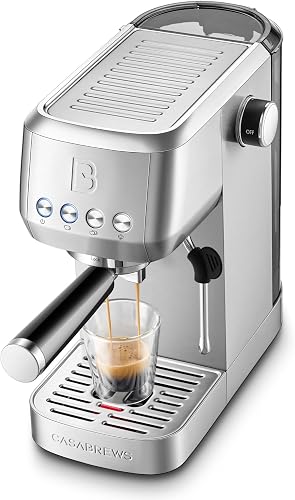
- 20 bar pump with 1350W heating system
- 43.9 fl oz removable tank
- PID temperature control
- Steam wand for milk
The largest tank in this group means fewer refills for a household that pulls several drinks each morning.
Pros
- Biggest water tank here
- PID temperature control
- Cup warmer on top
Cons
- Needs a separate grinder
- Deeper footprint than several picks
SHARDOR 20 Bar Touchscreen Espresso Machine: Best for touchscreen controls

- 20 bar pump with 1350W motor
- Touchscreen with single, double and manual modes
- Three temperature settings
- 45 fl oz removable tank
Puts shot size, temperature and steam behind a touchscreen, which some people find quicker to learn than a dial.
Pros
- Touchscreen with manual mode
- Three extraction temperatures
- One-touch descaling
Cons
- Tallest cabinet in this group
- Needs a separate grinder
AMZCHEF Compact Espresso Machine: Best for small kitchens

- 20 bar pump
- 1350W heating with 30 second preheat
- PID control within plus or minus 2 C
- 50 fl oz removable tank
A compact pump machine with a large tank and PID control, sized for apartment counters where space is tight.
Pros
- 50 fl oz tank
- PID control holds temperature within plus or minus 2 C
- Steam wand rotates 360 degrees
Cons
- Cup clearance under the spout is under 4 in
- Needs a separate grinder
The best budget espresso machines by what you drink
The Lavazza BLUE wins for most readers, but the right pick changes with your morning routine. A capsule drinker wants speed, while a milk-drink fan needs a steam wand and the patience to learn it.
There is also a middle path: a capsule machine that brews both a long coffee and a short espresso. That is what the Nespresso Vertuo Pop+ does, and it is why it sits between the two camps rather than inside either one.
Capsule machines for speed
The Lavazza BLUE Classy Mini and the Nespresso Vertuo Pop+ are the two pod options here. Both skip grinding and tamping, so the first cup of the day takes seconds rather than minutes.
The Lavazza is the smaller of the two at 5.3 in wide, and its two touch controls cover espresso and lungo. A programmable free dose lets you set one cup size to your taste.
Lungo is a longer, lighter pour than espresso, so the two buttons give you a short strong cup or a more drawn out one. Lavazza describes it as suited to a home, a small office or a hotel room.
Its 23.67 fl oz tank is on the small side, but for one or two cups a day that is not a chore to refill. Lavazza also dresses it in dark blue with chrome details, and the design won a Red Dot design award.
At 7.7 lb it is light enough to slide back against the wall when the counter needs clearing.
The Vertuo Pop+ adds range: five cup sizes from a single espresso up to a 12 oz coffee, brewed hot or over ice. It heats in about 30 seconds.
That makes it the better fit for a household where one person wants a long coffee and another wants a short shot. Nespresso's Centrifusion brewing reads the code on each Vertuo capsule and adjusts the brew to suit, so you are not choosing a strength setting yourself.
The 25 fl oz side tank refills without moving the machine, and the drip tray has two positions so a taller mug sits under the spout. The body is partly made from recycled plastic, and Nespresso capsules are recyclable through the brand's free program.
It also has a descaling alert and an auto shut-off, and a sample set of capsules comes in the box. The trade-off is size: at 14 in deep it takes more room front to back than the Lavazza, and neither pod machine can steam milk.
Pump machines for control
Everything else on this list takes ground coffee. You grind, dose, tamp and pull the shot yourself, which is more work but gives you a say in the result.
That say is the whole point of the pump side of this list, so expect to spend a week or two learning your grinder and your tamp before the shots settle down.
The Neretva 20 Bar is the strongest budget starting point in that group. It has pre-infusion to wet the puck evenly, a temperature display and a steam wand, and it includes a 51mm portafilter, two pressurized filters and a spoon and tamper.
That kit means you can start brewing without buying accessories beyond coffee. Its 1.31 L tank is the fourth largest here, and its body is the widest at 12 in across, so give it a full shelf rather than a corner.
At 17 lb it is the heaviest machine in the group, which matters if you move it to clean underneath.
If your counter is narrow, the best small affordable espresso machines roundup narrows the pump field further by footprint.
How we compared these budget espresso machines
We compared the specs and features of each machine against what a budget buyer actually needs: a consistent shot, a way to make milk drinks if wanted, and a footprint that fits a normal kitchen.
Our score weighs specs, features and buyer feedback against what you're shopping for. We did not run these machines side by side in a test kitchen, so the notes here come from the published specs and what each machine is built to do.
Four things separated the field. First, coffee input: capsules or ground coffee decides your ongoing cost and your control.
With capsules, the pod does most of the work and you only choose a button. With ground coffee, grind size, dose and tamp all change the cup, which is more to learn and more to enjoy.
Second, pressure and temperature: a 20 bar pump with pre-infusion and temperature control gives a more even extraction than a basic pump. Pre-infusion wets the coffee gently before full pressure, and steady water heat means a shot tastes the same from one morning to the next.
Pressure alone is not the whole story. A machine with a lower number, like the 15 bar De'Longhi Stilosa, can still make a good shot if your grind and tamp are right.
Third, milk: only the pump machines with a steam wand can froth. If lattes are the goal, look at how each wand works, since a manual wand, a one-touch steam button and a wand that rotates all feel different in use.
Fourth, size: width, depth and tank size decide where the machine fits and how often you refill. Height and cup clearance count too, because a tall machine or a short spout can rule out a good fit on paper.
We also gave a little weight to what comes in the box. A portafilter, filters and a tamper save you a shopping trip, though none of these machines include coffee or a grinder.
| Product | Best for | Coffee input | Width | Controls | Our score |
|---|---|---|---|---|---|
| Lavazza BLUE Classy Mini Single Serve Espresso | capsule simplicity | Lavazza Blue capsules | 5.3 in | Touch buttons | 9.4 |
| Neretva 20 Bar Espresso Machine Super Compact | barista practice on a budget | Ground coffee | 9.0 | ||
| Nespresso Vertuo Pop+ Coffee and Espresso Machine | coffee and espresso in one | Nespresso Vertuo capsules | 8.8 | ||
| CASABREWS CM5418 | latte art | Ground coffee | 8.5 | ||
| atatix Espresso Machine with Milk Frother | manual shot control | Ground coffee | Buttons and dial | 8.1 | |
| De'Longhi Stilosa | first-time pump machine owners | Ground coffee | 7.9 | ||
| CASABREWS 3700 Essential | refilling less often | Ground coffee | 7.7 | ||
| SHARDOR 20 Bar Touchscreen Espresso Machine | touchscreen controls | Ground coffee | 7.0 | ||
| AMZCHEF Compact Espresso Machine | small kitchens | Ground coffee | 6.8 |
Which budget espresso machine fits your counter?
Width matters more than total volume on a crowded counter. The Lavazza BLUE Classy Mini is the narrowest at 5.3 in, and the CASABREWS CM5418 is close behind at 5.47 in.
The atatix is right there too at 5 in wide, and the SHARDOR is 5.12 in. Four of the nine machines are under 5.5 in wide, so a narrow body is not hard to find in this group.
Depth is the second constraint. The Nespresso Vertuo Pop+ runs 14 in deep, the deepest here, while the atatix and Lavazza take less.
Measure your counter depth before you commit to a machine with a long body. A deep machine that sits under a cabinet can end up too far forward to reach the controls comfortably.
Height catches people out. The SHARDOR Touchscreen stands 15.27 in tall and the AMZCHEF 14.4 in, so check the clearance under your upper cabinets.
A machine that fits the width but not the height still ends up on a side table. The De'Longhi Stilosa at 14.17 in is in the same territory.
The Neretva is the shortest at 9.1 in and the easiest to tuck under a shelf.
Tank size affects daily routine as much as space. The Lavazza holds 23.67 fl oz, while the CASABREWS 3700 Essential holds 43.9 fl oz and the AMZCHEF's 50 fl oz removable tank is the biggest here.
A bigger tank means fewer refills but also more weight to lift when you clean it. The CASABREWS CM5418 sits in the middle at 34 fl oz, enough for several drinks but light enough to lift one-handed.
Capsule or ground coffee: which keeps costs down?
Capsules set your cost per cup and limit you to one pod system. The Lavazza BLUE takes Lavazza Blue capsules and the Vertuo Pop+ takes Nespresso Vertuo capsules, so neither can brew the other's pods.
Nespresso capsules are recyclable through the brand's free program, which softens the waste question if that matters to you. Pod systems also keep the machine simple: no grinder, no tamp, no basket to knock out and rinse.
Ground coffee gives you a wider choice of beans and roast levels. The catch is the grinder: none of the pump machines here include one, so add a burr grinder to your budget unless you already own one.
A grinder also decides how much control you really have, since grind size is the biggest single variable in a pump shot. The machines themselves support this: atatix recommends medium to dark roast beans ground to a slightly coarser setting, so you are not chasing the lightest roasts straight away.
For most people, capsules win on effort and pump machines win on variety. If you drink one style of coffee every morning and value speed, a capsule machine is the simpler buy.
If you like trying different roasts and are happy to spend ten minutes learning the workflow, the pump side repays that effort. One more cost to weigh: a pump machine needs descaling and a deep clean of the basket and wand, while a capsule machine asks mostly for a rinse and a descale cycle.
Do you need a steam wand?
Only if you drink lattes, cappuccinos or flat whites. The Lavazza and Vertuo Pop+ have no steam wand, so milk drinks mean heating and frothing milk separately.
That works fine for an occasional latte but gets old if milk is your default.
The pump machines here each have a steam wand. The CASABREWS CM5418 is built around textured microfoam for latte art, and the 3700 Essential adds a cup warmer on top.
The De'Longhi Stilosa uses a manual wand that mixes steam and milk for a rich froth. The atatix wand is designed to deliver dry, focused steam rather than weak bubbles, which is what gives you dense, glossy foam.
The SHARDOR puts steam behind a one-touch button. The AMZCHEF wand rotates through 360 degrees so you can angle the pitcher without moving the machine.
One habit to learn with any wand machine: froth milk after pulling the shot, not before. The CASABREWS CM5418 asks you to let the machine cool between frothing and the next brew so it does not trip its overheat protection.
On the AMZCHEF, water coming out of the wand before steam is normal condensation, and the manual tells you to release it first. The De'Longhi's manual wand gives you the most direct feel for the milk but also the least help, so it rewards a few practice pitchers.
How much pressure and control do you actually need?
A 20 bar pump is the common spec here, and it is more than enough for espresso. What matters more is how the machine manages that pressure during the shot.
atatix says its 20 bar system maintains 9 to 10 bar at the puck, which is the number that actually shapes the cup. The CASABREWS CM5418 adds a gauge so you can watch pressure as the shot runs.
A gauge is a teaching tool more than a necessity, but it shortens the learning curve when a shot runs too fast or too slow.
Pre-infusion, found on the Neretva and CASABREWS 3700 Essential, wets the puck at low pressure before full extraction. That tends to give a more even, balanced cup than a sudden full-pressure start.
The CASABREWS CM5418 also pre-infuses at low pressure.
Temperature control is the other lever. The atatix holds extraction in the 90 to 96 C range and preheats in about 30 seconds.
The SHARDOR offers three temperature settings and the AMZCHEF uses PID control within plus or minus 2 C. The 3700 Essential also uses PID.
A basic pump without temperature control still works, but expect to adjust your grind to compensate. The De'Longhi Stilosa relies on a stainless steel boiler for stable heat rather than a control loop, and the SHARDOR offers one-touch descaling so a scale build-up does not quietly undo that control.
If you want the simplest possible pump experience, the espresso machines that are easiest to use covers one-touch and dial machines in more detail.
What should first-time buyers skip?
Skip a built-in grinder and dual boiler at this budget. Neither appears in this group, and both push the price up without changing the cup much for a beginner.
A separate grinder you can upgrade later is the better spend.
Skip manual-only machines if you want milk drinks without practice. A wand takes a few tries to get microfoam right, and a machine with a one-touch steam option like the SHARDOR reduces the guesswork.
A steam knob still asks you to open and close it at the right moment, so factor in a little trial and error either way.
Skip a large tank if you brew one or two cups a day. A smaller tank is easier to empty and clean, and you will not notice the extra capacity.
The Lavazza's 23.67 fl oz tank is plenty for that pace.
Skip a tall machine if your cabinets are low. Measure twice: height is the spec people forget, and it is the one that sends a machine back.
The SHARDOR at 15.27 in and the AMZCHEF at 14.4 in both need real clearance.
Skip anything with tight cup clearance if you use travel mugs. The AMZCHEF asks for cups under 4 in tall, so a tall mug will not fit under its spout.
The Nespresso's two-position drip tray handles taller mugs better, which is worth noting if you like iced drinks.
Which machine fits an everyday home setup?
The best fit for everyday home use is the one you will actually use before work. For most people that means a capsule machine on the counter with pods in a jar beside it.
The Lavazza's two buttons and 5.3 in body make it the least fussy version of that setup.
If two people in the house want different drinks, the Vertuo Pop+ handles a long coffee and a short espresso without swapping machines. Its five sizes and 30 second heat up keep a shared morning moving.
For a single espresso drinker who wants to learn, a pump machine with pre-infusion and a steam wand gives room to grow. The Neretva's included portafilter and filters mean you are not shopping for extras on day one, and its temperature display helps you see what changed when a shot tastes off.
The CASABREWS 3700 Essential suits a household that pulls several drinks in a row, since its 43.9 fl oz tank and cup warmer carry you through a busy morning. The atatix fits the tinkerer who wants to set extraction time by hand: its manual mode runs up to 102 seconds and yields 180 to 350 grams of coffee, while its espresso mode pulls a single shot in 28 seconds or a double in 42.
Our guide to the best espresso machines for everyday home use goes deeper on matching a machine to a daily routine.
The verdict
The Lavazza BLUE Classy Mini is the best budget friendly espresso machine for most readers: small, simple and quick, with no grinder to buy. It suits anyone who wants a good cup without a routine, and its 5.3 in body barely registers on a counter.
Pick the Nespresso Vertuo Pop+ if you want coffee and espresso from one machine. Five cup sizes and a fast heat up make it the easier choice for a shared kitchen, as long as you are happy to stay with Vertuo capsules.
Choose the Neretva 20 Bar if you want to grind and tamp your own coffee and froth milk. Pre-infusion, a temperature display and a full starter kit make it a fair place to learn, though it is the heaviest machine here and you will need a grinder.
For latte art on a budget, the CASABREWS CM5418 has the wand and the gauge. Just remember to let it cool after frothing before the next shot.
A few others fill specific gaps. The De'Longhi Stilosa is a plain first pump machine, the atatix rewards anyone who wants to set extraction time by hand, and the CASABREWS 3700 Essential cuts down on refills with the biggest tank in the group bar the AMZCHEF.
The SHARDOR suits people who prefer a touchscreen, and the AMZCHEF suits small kitchens, with the caveat that cups must be under 4 in tall. Check height before you order either one.
And if counter space is the deciding factor, the Lavazza's 5.3 in width is hard to beat. If you go the pump route, set aside part of your budget for a grinder, because good grounds will do more for the cup than any extra spec.
Our top 3 picks at a glance
-
1
Best for capsule simplicity
Lavazza BLUE Classy Mini Single Serve Espresso
9.4/10 our score
See it on Amazon -
2
Best for barista practice on a budget
Neretva 20 Bar Espresso Machine Super Compact
9.0/10 our score
See it on Amazon -
3
Best for coffee and espresso in one
Nespresso Vertuo Pop+ Coffee and Espresso Machine
8.8/10 our score
See it on Amazon
Frequently asked questions
What makes an espresso machine budget friendly?
Budget friendly usually means a pump machine without extra features like a built-in grinder or dual boilers. Capsule machines also keep the upfront cost lower.
The savings often come from the machine itself while capsules or freshly ground beans carry the ongoing cost.
Is a capsule or pump machine better on a budget?
A capsule machine is easier to start with because there is no grinding or tamping. A pump machine gives you more control over the shot and lets you use any ground coffee.
Choose capsules for speed and pump machines for variety and technique.
Do budget espresso machines make real espresso?
Yes. Pump machines in this price range build enough pressure to pull a proper espresso shot, and several include pre-infusion and temperature control.
Capsule machines brew espresso-strength cups from sealed pods.
The cup depends more on your coffee and technique than on the machine's price.
How much counter space does a budget espresso machine need?
The models here run from about 5 in wide to 12 in wide. Leave a few inches behind and beside the machine for the tank and steam wand.
A narrow body like the Lavazza BLUE Classy Mini or the CASABREWS CM5418 fits a tight counter best.
Can a cheap espresso machine froth milk?
The pump machines in this group with a steam wand can froth milk for lattes and cappuccinos. Capsule machines here do not include a wand.
If milk drinks matter most, pick a pump machine with a steam wand and budget for a grinder too.
How often do I need to descale a budget espresso machine?
Descale when the machine alerts you or when shots start tasting flat. How often depends on your water hardness and how many cups you brew.
Soft water and regular rinsing stretch the time between descaling sessions.


