8 Best Coffee Grinders for Espresso Beginners (November 2026)
The best espresso coffee grinders for beginners include the Baratza Encore ESP for clear espresso grind steps, the Fellow Opus 2 Conical Burr Grinder for tiny grind changes, and the Breville Smart Grinder Pro BCG820 for timed dosing.
On this page (5 sections)
The Baratza Encore ESP is the best coffee grinder for espresso beginners who want a clear range of espresso adjustments and a simple daily routine. Fellow Opus 2 offers stepless control for smaller changes, while Breville’s Smart Grinder Pro adds timed dosing and a display.
A grinder matters because espresso needs a fine, adjustable grind. The right choice depends on how much control you want, whether you change brew methods, and how you prefer to transfer grounds to your portafilter.
If you're also choosing a machine, start with our guide to espresso machines for beginners. If your machine includes a grinder, compare that setup with the differences in our espresso grinder vs coffee grinder guide.
Our picks at a glance
-
1
-
2

-
3

- 4
 Best for hands-free grinding modesCheck it
- 5
 Check it
Viesimple Gen 4 Single Dose Grinder
Best for a compact single-dose setup - 6
 Check it
SHARDOR Conical Burr Espresso Grinder
Best for timed portafilter grinding - 7
 Check it
AMZCHEF Single Dose Coffee Grinder
Best for switching beans - 8
 Best for larger bean batchesCheck it
Which coffee grinder is best for espresso beginners?
The Baratza Encore ESP is the best starting point for many beginners because its numbered range separates espresso micro-steps from coarser filter settings. The other picks make sense when you want stepless adjustment, timed dosing, a compact single-dose routine, or a larger hopper.
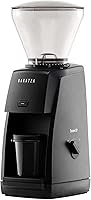
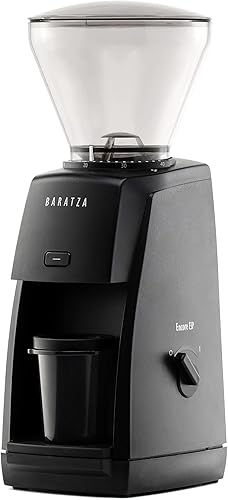
Baratza Encore ESP: Best for clear espresso grind steps
- Micro-steps from 1 to 20 for espresso
- Macro-steps from 21 to 40 for filter coffee
- Quick-release burr system
- 40 mm hardened alloy steel burrs
The split adjustment range gives beginners a distinct espresso area and room to move to filter coffee. A front pulse button and simple on/off switch keep the controls direct.
Pros
- Dedicated micro-step range for espresso
- Quick-release burr for cleaning
- Supports espresso through cold brew
Cons
- Stepped adjustment limits changes to its set increments
- No timed dosing control
The Encore ESP gives you micro-steps from 1 to 20 for espresso, then macro-steps from 21 to 40 for filter brewing. That split creates a useful starting map when you're learning how small grind changes affect a shot.
A single-handed hopper twist changes the setting, and you can grind with the front pulse button or the on/off switch. It also has a quick-release burr mounting system, so cleaning doesn't require taking the entire grinder apart.
The 120 g capacity is a practical size for home use, while the stated 40 mm hardened alloy steel burrs are designed for espresso and other methods. Baratza describes this model as suitable from espresso to cold brew.
Choose it if you want defined steps and a straightforward control layout. If you move between espresso and filter coffee, the two adjustment ranges make it easier to keep track of a useful setting for each.
Fellow Opus 2 Conical Burr Grinder: Best for tiny grind changes
- Stepless adjustment
- 48 mm conical burrs
- Two magnetic catch cups
- Automatic shutoff
Its continuous adjustment lets you make small changes when a shot needs finer tuning. The espresso catch cup fits 54 mm and 58 mm portafilters.
Pros
- Fine adjustment without fixed steps
- Espresso cup supports common portafilter sizes
- Tool-free burr access
Cons
- More adjustment freedom may take practice
- No capacity figure provided
Fellow Opus 2 suits beginners who want to make very small grind changes while dialing in espresso. Its stepless adjustment moves continuously, so you aren't limited to fixed stops between settings.
The 48 mm conical burrs are designed for espresso and other brew methods. The grinder comes with two magnetic catch cups, including an espresso cup compatible with 54 mm and 58 mm portafilters.
Fellow also includes a grind guide under the lid, automatic shutoff and tool-free burr access. Its near-zero retention design aims to reduce old grounds carrying into the next dose, and anti-static technology is intended to reduce scattered grounds.
The extra adjustment freedom can be helpful as you learn how a shot responds to small changes. Choose it if you expect to brew more than espresso and want one grinder for pour-over, French press and cold brew too.
Breville Smart Grinder Pro BCG820: Best for timed dosing
- 60 grind settings
- Dose time adjusts in 0.2-second steps
- LCD shows setting and grind time
- Portafilter cradles included
The digital timer gives you a repeatable starting dose, while the display shows the selected setting and time. It can grind directly into a portafilter or container.
Pros
- Wide range of grind settings
- Fine timer increments
- Two portafilter cradle sizes included
Cons
- More controls to learn than a simple pulse button
- Timer alone does not determine the right dose
The Breville Smart Grinder Pro suits a beginner who wants grind time to be easy to repeat. Its 60 settings and 0.2-second timer increments offer a broad range of adjustments and control over grind duration.
The LCD displays the grind setting, grind time and selected number of shots or cups. You can grind into a portafilter, an airtight container, a gold-tone filter basket or a paper filter.
Two portafilter cradles are included: one for 50 to 54 mm and one for 58 mm. The grinder also has pre-programmed settings and a stated 18 oz bean hopper capacity.
A timer helps you return to a familiar routine, but dose by weight if you need a precise amount of coffee. Choose this model if you value the display and want controls for espresso and other brewing methods in one grinder.
Baratza Encore ESP Pro: Best for hands-free grinding modes
- Stepless grind adjustment
- Single Dose and Timer modes
- 0.1-second dosing accuracy
- Active anti-static technology
Choose this model if you want stepless changes plus a single-dose mode with auto-stop or a timer mode. Its display and illuminated grounds bin add feedback during grinding.
Pros
- Two hands-free grinding modes
- Quick-release burr system
- Flow control disk manages bean flow
Cons
- Its range of controls may be more than a first setup needs
- No burr size is specified here
Baratza Encore ESP Pro suits beginners who want hands-free grinding options and stepless adjustment. Its Single Dose Mode has auto-stop, while Timer Mode offers dosing accuracy in 0.1-second increments.
The display uses a single rotary knob, and LEDs illuminate the grounds bin while coffee is grinding. The active anti-static feature is designed to reduce mess, and the removable flow control disk manages how beans feed into the burrs.
Like the Encore ESP, this grinder has a quick-release burr system for tool-free removal during cleaning and maintenance. Its 120 g capacity and 40 mm dimensions make it similar in footprint to the standard ESP.
Choose it if you want a more guided workflow with a display and two grinding modes. If you'd rather begin with simpler controls, the standard Encore ESP is easier to approach.
Viesimple Gen 4 Single Dose Grinder: Best for a compact single-dose setup
- 30 g capacity
- 48 mm conical burrs
- Magnetic dosing cup
- Anti-static coating
The small stated capacity suits weighing beans for one brew at a time. Its magnetic cup and anti-static design aim to keep the transfer area tidier.
Pros
- Compact dimensions
- Magnetic dosing cup
- Designed for several brew methods
Cons
- Small capacity limits batch size
- No adjustment increment details provided
The Viesimple Gen 4 fits a compact, single-dose routine. Its 30 g capacity is smaller than the hopper-style grinders here, so it works best when you measure beans for each brew instead of keeping a large batch ready.
The grinder has 48 mm conical burrs and a magnetic dosing cup. Its anti-static coating and blow-out funnel design aim to keep more grounds in the cup and reduce cleanup around the grinder.
Viesimple describes the motor as quiet and gives a 2-year warranty. The listed dimensions are 6 x 3 x 9 inches, which may help if counter space is tight.
Choose it when a small footprint and dosing cup matter more than batch capacity. The adjustment increment details aren't specified, so consider that if you want especially fine control while dialing in.
SHARDOR Conical Burr Espresso Grinder: Best for timed portafilter grinding
- 51 grind settings
- Timer adjusts in 0.1-second steps
- Portafilter cradle
- Anti-static design
The cradle lets you grind into a portafilter, and the timer adjusts in small increments. Its range also covers coarser methods such as French press.
Pros
- Portafilter cradle included
- Precise timer increments
- Broad grind range
Cons
- Small stated capacity
- Portafilter activation workflow may take setup
SHARDOR offers 51 settings and a timer that changes in 0.1-second steps, giving you both grind range and control over duration. Its portafilter cradle lets grounds go directly into the handle.
The grinder uses 40 mm stainless steel conical burrs and includes a dosing ring, cleaning brush and grounds residual cleaner. Anti-static technology is intended to reduce clinging grounds in the chamber.
For a new espresso user, the timer and portafilter workflow can make the routine more repeatable. The capacity is 1.4 oz, so keep that limit in mind if you plan to grind several drinks at once.
Choose it if direct portafilter grinding and timed control are priorities. Follow the setup instructions for the cradle and activation switch before your first use.
AMZCHEF Single Dose Coffee Grinder: Best for switching beans
- 75 grind settings
- Retention as low as 0.1 to 0.2 g
- Magnetic outlet
- 58 mm and 51 or 54 mm dosing funnel stands
Frequent bean changes are the focus: its detachable magnetic outlet and knock tool help clear the path between doses. The included stands suit several portafilter sizes.
Pros
- Many adjustment settings
- Designed for lower retention
- Dosing stands for multiple sizes
Cons
- Many settings can take time to learn
- No burr size is specified here
AMZCHEF Single Dose gives you 75 grind settings and features aimed at switching beans with less carryover. Its magnetic outlet detaches, and the included knock tool helps clear the grinding path between doses.
The brand describes retention as low as 0.1 to 0.2 g. Anti-static technology aims to reduce grounds around the outlet, and the timer can be set from 5 to 60 seconds.
Included dosing funnel stands accommodate 58 mm and 51 or 54 mm setups. The 120 g capacity is larger than a typical single dose, so you can still keep a measured workflow while changing beans as needed.
Choose this grinder if you frequently rotate between coffees and want many settings to explore. Its broad range may take more time to learn than a grinder with a smaller, clearly divided espresso range.
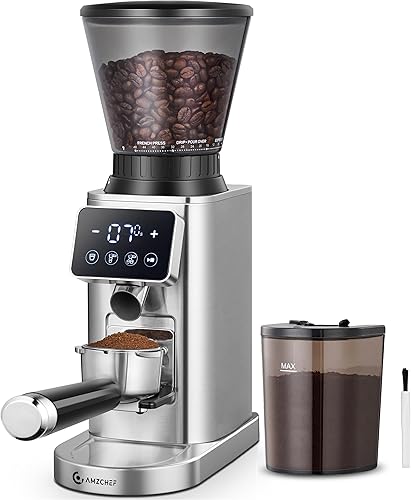
AMZCHEF Burr Coffee Grinder: Best for larger bean batches
- 48 grind settings
- 10.6 oz hopper
- 2 to 12 cup selection
- Anti-static technology
A larger hopper and cup selection suit someone who wants beans ready for more than one espresso session or other brewing methods. Manual mode allows you to start or stop grinding.
Pros
- Largest stated bean capacity here
- Touchscreen controls
- Supports espresso through cold brew
Cons
- Cup selection may not match an espresso dose exactly
- No portafilter cradle details provided
This AMZCHEF grinder suits households that want a larger bean hopper for more than one brewing session. The hopper holds 10.6 oz, and touchscreen controls let you choose 2 to 12 cups, set a grind time or use manual mode.
Its 48 settings cover espresso through French press and cold brew. The grinder has 40 mm stainless steel conical burrs, a stainless steel container and anti-static technology intended to reduce cling and spills.
The cup selector is designed for batch grinding, so it may not match a single espresso dose precisely. Use a scale to confirm your dose when preparing espresso rather than relying on cup count.
Choose it if capacity and touchscreen control matter more than a single-dose workflow. For a small espresso setup, the Encore ESP or Opus 2 offers a more focused route to dialing in.
What features matter in an espresso grinder?
The most useful espresso grinder features are fine adjustment, repeatable dosing and a workflow you can manage before brewing. You don't need every available setting, but you do need a way to make small changes when a shot runs too quickly or slowly.
How much grind adjustment does a beginner need?
A dedicated espresso range or stepless adjustment can help you find a workable grind more easily. The Encore ESP marks out micro-steps for espresso, while Fellow Opus 2 and Encore ESP Pro allow continuous adjustment.
A larger setting count doesn't automatically make a grinder easier to learn. Look for a clear starting point, then change one step at a time and note what happens to the shot.
Does a timer make espresso dosing easier?
A timer can help you repeat the same grinding duration, but it doesn't measure the coffee itself. Breville and SHARDOR offer fine timer increments, while the Encore ESP Pro has a timer mode and single-dose mode with auto-stop.
If dose consistency matters, weigh the coffee. You can then use the timer as a convenient starting routine and adjust it when the grind setting or beans change.
Should you choose a hopper or single-dose grinder?
Choose a hopper if you want beans ready to grind, and a single-dose design if you prefer measuring each brew. The Breville and larger AMZCHEF have larger stated capacities, while the Viesimple Gen 4 has a 30 g capacity.
A single-dose workflow makes it easier to switch beans without keeping a large amount in the hopper. A hopper can make daily use simpler when you tend to brew the same coffee.
How do you choose a grinder for your espresso machine?
Choose a grinder that can feed grounds into your portafilter or cup and adjust fine enough for your machine and basket. Check portafilter compatibility if you want to grind directly into the handle.
Fellow Opus 2 includes an espresso cup compatible with 54 mm and 58 mm portafilters. Breville includes cradles for 50 to 54 mm and 58 mm portafilters, while SHARDOR includes a cradle for direct grinding.
Your basket also affects how forgiving the setup feels. Our guide to pressurized vs non-pressurized espresso baskets explains the difference and can help you match your grinder expectations to your machine.
For a new machine and grinder setup, see how to pick an espresso machine as a beginner. Once you have both, our espresso dial-in guide walks through changing grind and dose in a practical order.
What grind should you start with for espresso?
Start with a fine setting, then adjust based on how the shot flows and tastes. The right grind varies with the beans, basket and machine, so use the grinder's espresso range as a starting point rather than a fixed answer.
If the shot runs too quickly, try a finer setting; if it runs too slowly, try a coarser setting. Change one variable at a time so you can tell what helped.
Read our guide to what grind size is right for espresso for more detail. If a shot tastes sour or bitter, those guides can help you check grind and other brewing variables: fixing sour espresso and fixing bitter espresso.
Which espresso grinder should you choose?
Choose the Baratza Encore ESP if you want a clear espresso range and direct controls, Fellow Opus 2 if you want continuous adjustment, or Breville Smart Grinder Pro if timed dosing and a display matter most. Pick a compact single-dose model for measured bean changes, or a larger hopper for batch convenience.
A grinder gives you the control to adjust espresso as you learn. Start with a manageable range, make small changes, and keep notes on the settings that work for your coffee.
For the next step, use our guide to dialing in espresso on a home machine.
| Product | Best for | Adjustment | Capacity | Burrs | Our score |
|---|---|---|---|---|---|
| Baratza Encore ESP | clear espresso grind steps | 40 steps across espresso and filter ranges | 120 g | 40 mm hardened alloy steel | 9.0 |
| Fellow Opus 2 Conical Burr Grinder | tiny grind changes | Continuous, stepless | 48 mm conical | 8.8 | |
| Breville Smart Grinder Pro BCG820 | timed dosing | 8.7 | |||
| Baratza Encore ESP Pro | hands-free grinding modes | Stepless | 120 g | 8.6 | |
| Viesimple Gen 4 Single Dose Grinder | a compact single-dose setup | 30 g | 48 mm conical | 7.6 | |
| SHARDOR Conical Burr Espresso Grinder | timed portafilter grinding | 1.4 oz | 40 mm stainless steel conical | 7.5 | |
| AMZCHEF Single Dose Coffee Grinder | switching beans | 120 g | 7.3 | ||
| AMZCHEF Burr Coffee Grinder | larger bean batches | 40 mm stainless steel conical | 7.0 |
Our top 3 picks at a glance
-
1
-
2
-
3
Frequently asked questions
What should a beginner look for in an espresso grinder?
Look for fine adjustment, a repeatable way to dose, and a workflow that fits your machine. The Baratza Encore ESP has a dedicated micro-step range for espresso, while the Breville Smart Grinder Pro adds a digital timer.
Check that the grinder can grind fine enough for your basket and that its dosing method suits how you prepare coffee.
Is stepless adjustment better for espresso?
Stepless adjustment allows tiny changes between grind settings, which can help when a shot runs too quickly or slowly. Fellow Opus 2 and Baratza Encore ESP Pro use continuous adjustment.
Stepped grinders can be easier to learn because each position is defined.
A good choice depends on whether you value simpler steps or finer control.
Can one coffee grinder work for espresso and other brew methods?
Yes. Several grinders here cover espresso and coarser methods, including the Baratza Encore ESP, Fellow Opus 2 and Breville Smart Grinder Pro.
If you switch between methods, note the grind setting that works for each one.
Espresso often needs a much finer setting than French press or cold brew.
Do beginners need a grinder with a timer?
A timer can help you repeat a starting grind duration, but it does not guarantee the same coffee dose every time. Bean type, grind setting and other factors can affect how much coffee comes through.
Use a scale if dose consistency matters.
A pulse or manual mode gives you direct control while you learn.
How fine should espresso grind be?
Espresso grind is usually fine, but the right setting depends on the beans, basket and machine. Start with a setting suited to espresso, then adjust based on how the shot flows and tastes.
Our guide to what grind size is right for espresso explains how to make those changes.